


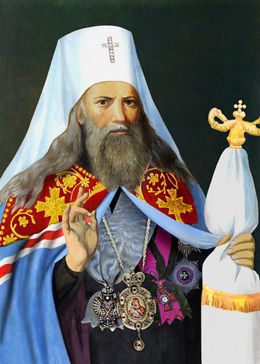
 Baptismal Name: Grigorie
Place of Birth: Bistrița, Transylvania
Date of Birth: 1746, 18th century
Date of Death: March 30, 1821, Chișinău, 19th century
Enthronement: February 10, 1792
Retirement: after May 16, 1812
Affiliation: Russian Orthodox Church
Education: Theological Academy of Kiev
Biography:
Gavriil (born Grigorie Bănulescu-Bodoni) was Metropolitan of Moldova, Poltava, and Kiev, and later Metropolitan of Bessarabia.
A Romanian scholar and church leader, Gavriil Bănulescu-Bodoni was also an ecclesiastical writer. He was born in 1746 in Bistrița, Transylvania, into a family of ruined nobility (răzeși), who had originally fled from Moldova.
He completed his early studies in Transylvania, then attended the Theological Academy in Kiev (1771–1773), Greek schools in Patmos and Smyrna, and the Vatopedi Monastery on Mount Athos (1773–1776).
In 1776, he became a teacher in Transylvania, and in 1777 he taught in Iași. In 1779, he was tonsured a monk in Constantinople with the name Gavriil, continuing his studies in Patmos (1779–1780).
Between 1781 and 1782, he served as a Greek language teacher, hieromonk, and preacher at the metropolitan cathedral in Iași. From 1782 to 1784, he was a professor at the seminary in Poltava, Russia.
He returned to Iași in 1784 and was consecrated archimandrite in 1786. He was proposed as bishop of Roman, but the fanariot ruler at the time did not approve. Later that year, he returned to Russia and became rector of the Poltava Seminary (1786–1791).
On December 26, 1791, Archbishop Ambrose Serebrennikov of Poltava (also appointed by the Holy Synod of the Russian Orthodox Church as overseer of the Church in Moldova, 1788–1792) consecrated Gavriil as bishop-vicar of Akkerman and Bender (Cetatea Albă and Tighina).
On February 10, 1792, the Holy Synod of the Russian Orthodox Church appointed him Metropolitan of Moldova, but in April the new ruler, Alexandru Moruzi, sent him under arrest to Istanbul.
He was later released through the intervention of the Russian representative at the Porte and returned to Russia, where he was appointed Metropolitan of Poltava (1793–1799), then of Kiev (1799–1803). In 1801, Tsar Alexander I appointed him a member of the Holy Synod of the Russian Orthodox Church. He retired in 1803, settling in Odessa.
On March 27, 1808, by decree of the same tsar, he was appointed Exarch of the Church in Moldova and Wallachia—both regions under Russian influence and administration—leading the Metropolis of Moldova until after the Peace of Bucharest (May 16, 1812). In this role, he published several books and worked to ensure the proper functioning of church life.
On August 21, 1813, the Tsar of Russia appointed him head of the newly created Archdiocese of Bessarabia, with residence in Chișinău, established at his request.
At the initiative of Metropolitan Gavriil in 1814, a printing press was opened in Bessarabia, where important books for worship and for all Orthodox people were published.
Taking care of church buildings, Metropolitan Gavriil was also involved in civic activities.
At that time, various ill-intentioned individuals disturbed the inhabitants of Bessarabia with false rumors, inciting them against Russia and encouraging the population to relocate from Russia across the Prut or the Danube. Metropolitan Gavriil, through his address to the people, refuted these confusing rumors and received confirmation from the Russian government that Bessarabia had its own civil administration, thereby preserving and strengthening the alliance between Russia and Bessarabia.
During his more than seven years of leading the Diocese of Chișinău, Metropolitan Gavriil achieved significant accomplishments. No aspect of the life and activity of the Church in Bessarabia was neglected. All plans for educating the faithful, despite facing serious obstacles, were successfully implemented.
Metropolitan Gavriil shepherded the Archdiocese of Bessarabia until his death, where he also founded a Theological Seminary.