




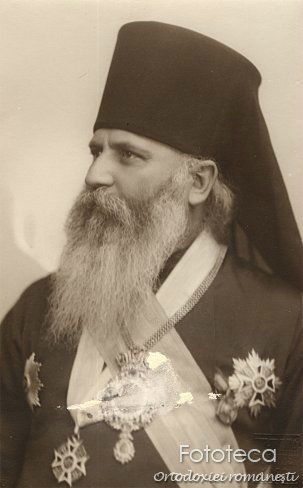
Rank: Metropolitan
Place of Birth: Nimoreni, Lăpușna
Born: January 1, 1877
Died: November 14, 1943
Enthronement – Retirement: 1928 – 1936
Affiliation: Romanian Orthodox Church
Education: Theological Academy
Biography:
Metropolitan Gurie (Gheorghe Grosu) was an extremely devout man and one of the promoters of national values in Bessarabia.
He studied at the Spiritual School (1888–1892) and at the Theological Seminary in Chișinău (1892–1898), and then, between 1898 and 1902, at the Theological Academy in Kiev, founded by Romanian Metropolitan Petru Movilă, where he obtained the title of Master in Theology.
He was tonsured a monk at Noul Neamț Monastery in Chițcani, ordained hieromonk, and appointed “diocesan missionary” (1902). Later, he was elevated to protosyncellus and archimandrite (1909). He earned the merit of establishing a diocesan printing press (1896) and founding the magazine Luminătorul in Chișinău (1908).
He served as abbot at St. Abraham Monastery in the Smolensk Governorate (1909), director of teacher-training schools in Grușevsk (1910–1914) and Samovka (1914–1917), professor of Romanian language in Chișinău (1917–1918), and was an advocate of Romanian national identity in his capacity as Deputy Minister of Justice in the provisional government in Chișinău.
On July 4, 1918, he was elected by the Holy Synod in Bucharest as vicar bishop of the Metropolis of Moldavia, with the title “Botoșăneanul” (consecrated in Iași on July 15, 1918). In 1919, he was appointed vicar bishop of the Archdiocese of Chișinău (with the title “of Bălți”); on January 1, 1920, he became acting Archbishop of Chișinău and Hotin. On February 21, 1920, he was elected titular Archbishop (enthroned in 1921), and from April 28, 1928, he became Metropolitan of Bessarabia, shepherding the Church until November 11, 1936, when he was pensioned.
During King Carol II’s visit to Bessarabia in 1930, Metropolitan Gurie prevented him from entering the altar through the Royal Gates, telling him that a king could do so only if he wore the crown on his head and together with his lawful wife, Princess Elena of Greece. In this way, he reproached the king for extramarital relations. This act was never forgiven by the king, who created a campaign against Gurie, greatly exaggerating the events that had occurred. He was accused of abuses and mismanagement, being investigated by the Court of Cassation, which never completed the inquiry. Under pressure from the king, the Holy Synod, led by Patriarch Miron Cristea, temporarily suspended him on November 11, 1936, without taking into account the letter Gurie had sent.
Works:
- Instruction Book on God’s Law, compiled after several Russian manuals, Chișinău, 1908
- Moldovan Spelling Book, Chișinău, 1909
- Moldovan Primer, Chișinău, 1917 (in collaboration; 2nd and 3rd editions in Latin letters, 1918; 7th edition, 1922)
- Prayer and Their Explanation, Chișinău, 1920, 44 p.
- On the Human Being: Physical, Spiritual, and Moral, Chișinău, 1924
- Sacred History of the Old and New Testament, Chișinău, 1924 (and other editions)
- The Service of God by a Good Priest, after Father John of Kronstadt, Chișinău, 1925
Translations from Russian:
- History of Noul Neamț Monastery, Chișinău, 1911; M. Calnev
- On the Veneration of Holy Icons, Chișinău, 1920
- Numerous other translations and adaptations from Russian, including brochures, articles, sermons, speeches, and pastorals, mainly published in the periodicals Luminătorul and Misionarul, or in newspapers such as Cuvânt Moldovenesc, România Nouă, etc. (all published in Chișinău).